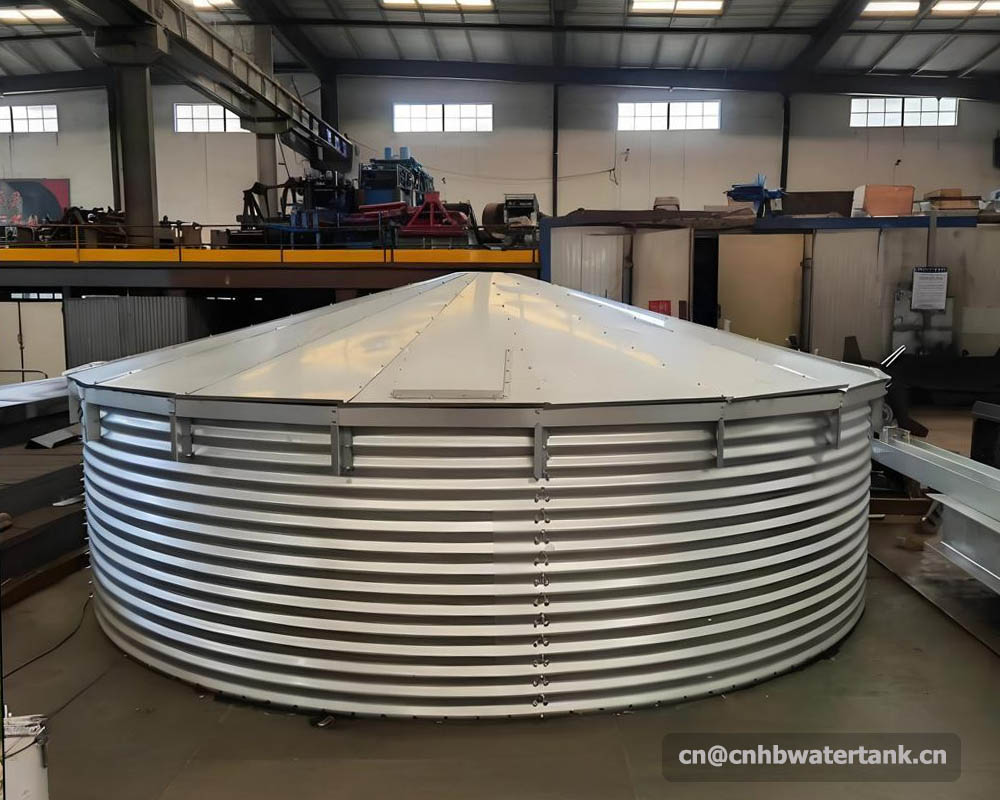

Yes, a corrugated steel water tank with a PVC liner can generally be used for wastewater storage or containment, provided the PVC liner is specifically designed and properly installed for wastewater applications.
Here’s a detailed explanation:
✅ Why It Can Work:
- PVC Liner Provides Protection:
- The primary role of the PVC (Polyvinyl Chloride) liner is to act as a chemical-resistant barrier between the wastewater and the corrugated steel structure.
- High-quality, thick PVC liners (e.g., reinforced PVC or flexible membrane liners like those used in lagoons) are resistant to a wide range of chemicals, biological agents, and varying pH levels commonly found in municipal or certain industrial wastewaters.
- Steel Provides Structural Strength:
- Corrugated steel offers excellent structural support, allowing the tank to handle large volumes and external loads, while the PVC liner handles the chemical exposure.
- Cost-Effective Solution:
- Combining durable steel with a PVC liner is often more economical than using fully plastic (e.g., polyethylene) or fiberglass tanks for large-capacity installations.
- Common Use in Practice:
- This type of tank is frequently used for:
- Stormwater retention
- Greywater storage
- Municipal sewage balancing tanks
- Industrial process water (non-extreme chemistries)
- Sludge holding (if liner is abrasion-resistant)
- This type of tank is frequently used for:
⚠️ Important Considerations and Limitations:
- Type of PVC Liner Matters:
- Not all PVC is equal. The liner must be:
- Thick enough (typically 1.5 mm to 2.0 mm or more).
- Reinforced (e.g., scrim-reinforced PVC) for durability and puncture resistance.
- Designed for wastewater, not just potable water.
- Resistant to UV (if exposed), biological growth, and temperature fluctuations.
- Not all PVC is equal. The liner must be:
- Wastewater Composition:
- Suitable for: Municipal sewage, greywater, stormwater, mildly contaminated industrial water.
- Not suitable for: Highly aggressive chemical waste (e.g., strong solvents, concentrated acids/alkalis, hydrocarbons) that could degrade PVC over time.
- Liner Installation & Seams:
- The liner must be seamlessly welded or properly overlapped and sealed by trained professionals.
- Any defect, puncture, or poor seam can lead to leakage and rapid corrosion of the steel underneath.
- Abrasion and Mechanical Damage:
- If the wastewater contains solids or grit, it may abrade the liner over time. Consider liners with abrasion-resistant properties.
- Temperature Limits:
- Standard PVC has a limited temperature range (usually -10°C to +60°C). Hot wastewater may soften or deform the liner.
- Regulatory Compliance:
- Ensure the tank system meets local environmental regulations for wastewater storage, including requirements for secondary containment, leak detection, and emissions (e.g., H₂S gas from sewage).
- Maintenance:
- Regular inspection of the liner for wear, tears, or degradation is essential.
- Avoid sharp objects during cleaning or maintenance.
✅ Best Practices:
- Use reinforced, wastewater-grade PVC liner (e.g., similar to geomembranes used in ponds or lagoons).
- Ensure full coverage of the steel, including walls, floor, and connections.
- Install protective layers (e.g., geotextile underlayment) if the base is rough.
- Provide proper inlet/outlet fittings that are compatible and sealed to the liner.
- Consider ventilation for sewage tanks to prevent gas buildup.
✅ Conclusion:
Yes, a corrugated steel tank with a properly specified and installed PVC liner is a viable and commonly used solution for wastewater storage, especially for municipal and non-extreme industrial applications.
However, success depends entirely on:
- The quality and suitability of the PVC liner,
- The correct installation,
- The nature of the wastewater, and
- Ongoing maintenance and inspection.
🔹 Recommendation: Always consult with the tank and liner manufacturer to confirm compatibility with your specific wastewater type, and involve an engineer if used for regulated or large-scale applications.