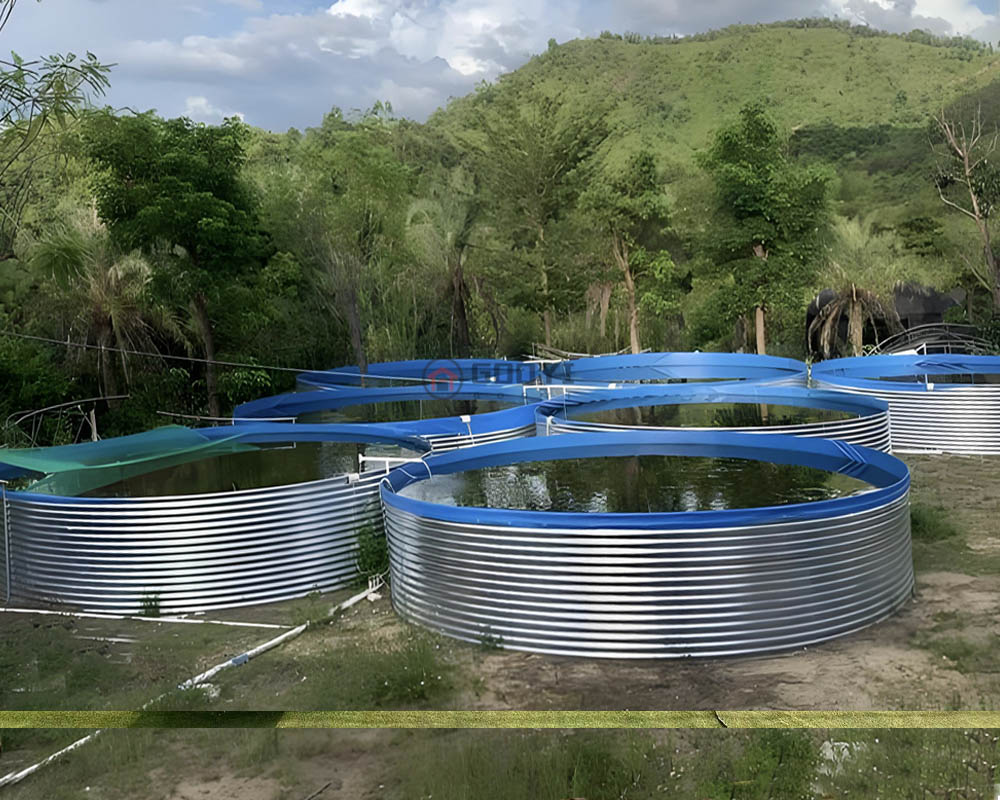

Selecting the correct size for your round corrugated galvanized steel tank is not just a purchase decision—it's a critical investment in the future efficiency and profitability of your aquaculture operation. This guide provides the framework you need to make an informed choice.
Practical Recommendations
Application Recommended Diameter Recommended Depth Key Rationale Hatchery / Nursery / Research 3m - 5m 1.0m - 1.3m Maximum control, ease of management, efficient feeding. Standard Grow-Out (Most Species) 6m - 8m 1.6m - 1.8m Best balance of cost, capacity, and operational ease. Highly recommended. Large-Scale, Intensive Grow-Out 10m - 12m 1.8m - 2.2m For experienced operators seeking lowest unit cost. Requires excellent engineering and management.
🔍 Why Tank Size is a Strategic Decision
The dimensions of your tank directly influence nearly every aspect of your farm's performance. An optimally sized tank promotes fish health through efficient waste removal and water quality management, while a poorly sized one can lead to chronic stress, higher disease risk, and increased operational costs. Your choice impacts:
- Capital Expenditure: Costs for the tank itself, foundation, and supporting infrastructure.
- Operational Workflow: Ease of feeding, monitoring, grading, and harvesting.
- System Scalability: Flexibility for future expansion or operational changes.
📐 The Core Dimensions: Diameter vs. Depth
Understanding the interplay between diameter (footprint) and depth (water volume) is essential.
◯ Diameter: Defining Your Farm's Layout
The diameter determines the tank's surface area and spatial requirements.
- ● Small Diameter (3m - 6m): Ideal for hatcheries, nursery stages, research, or holding high-value broodstock. Offers superior management control and the most efficient solids removal.
- ● Medium Diameter (6m - 10m): The most recommended range for commercial grow-out. Provides an excellent balance of water volume, manageable operations (like seining), and cost-effectiveness. An 8m diameter is an industry favorite.
- ● Large Diameter (10m+): Suited for large-scale, intensive operations with advanced automation. Maximizes water volume per footprint but requires significantly more powerful aeration and water circulation to ensure effective self-cleaning.
⬇ Depth: Utilizing the Water Column
Depth dictates total water volume and influences environmental stability.
- ▶ Standard (1.5m - 1.8m): Works well for most finfish. Provides adequate volume without excessive wall pressure.
- ▶ Shallow (<1.5m): Common in shrimp culture or specific treatment systems.
- ▶ Deep (1.8m - 2.4m): Increases stocking capacity without using more floor space. Requires mandatory bottom-mounted diffused aeration to prevent dangerous oxygen gradients.
⚖️ Key Ratio: Maintain a Diameter-to-Depth Ratio between 4:1 and 6:1 for optimal hydraulic flow. Example: An 8m (diameter) x 1.6m (depth) tank has a perfect 5:1 ratio.
📝 Your 5-Step Sizing Selection Checklist
Follow this actionable process to determine your ideal tank size.
- Define Primary Parameters: Identify target species, desired final weight, and annual production goals.
- Calculate Volume Requirement: Use the formula:
Total Volume (m³) = Annual Production (kg) / Target Stocking Density (kg/m³) / Number of Cycles.
Unsure about realistic densities? Professional advice is key. - Design the Farm Layout: Mock up your facility with tanks to scale. Prioritize access space for personnel and equipment. Often, multiple medium tanks are a lower-risk, more flexible strategy than a single, very large tank.
- Match Supporting Infrastructure: Your tank size dictates the capacity of your filtration, pump, and aeration systems. Ensure your life support equipment is specified to handle the chosen water volume and biomass.
- Consult with an Expert Supplier: Engage with a technical supplier early. They can validate your design, advise on local engineering standards (e.g., wind load), and suggest optimizations.
✅ The Advantage of Partnering with a Professional Manufacturer
Beyond size, quality and integration are paramount. A reputable manufacturer provides:
- Engineered Durability: Tanks constructed from high-grade, corrosion-protected galvanized steel with structural integrity for long-term use.
- Precision Manufacturing: Consistent panel design for easy, leak-free assembly.
- Integrated System Design: Properly sized and placed inlets, drains, and accessories that work seamlessly with the tank's hydraulics.
- Customization Capability: Ability to tailor dimensions to your specific project needs, not just limited to standard sizes.
🚀 Take the Next Step: From Concept to Installation
Making the right choice in tank size is foundational to your project's success. Let our expertise guide you.
Contact us for a free, professional sizing consultation. Share your basic project outline, and our engineering team will provide tailored recommendations and a comprehensive quote for a complete tank system solution.
Invest in the foundation that guarantees performance. Let's build a more efficient and profitable aquaculture operation together.